New Monkey Species Discovered
Topics—
Latest—

Newly Discovered Monkey Pops Up in Camera Trap Footage

Rare Water Mouse Rediscovered After Almost 100 Years

Striking Photos Reveal the Legacy of Yellowstone’s Wolves

The Hidden Ways Wolves Keep an Ecosystem Healthy
Nat Geo Recommends—
Meet the First New Cat Species Discovered in 100 Years
Topics—
Latest—

Michelangelo and the Tomb that Tormented Him

premium
A Famous Portrait of Anne Boleyn Hides a Strange Secret

premium
Will the Bayeux Tapestry Finally Give Up Its Secrets?
How Sleuths Decoded the Secret Letters of Mary, Queen of Scots

How Sleuths Decoded the Secret Letters of Mary, Queen of Scots
Nat Geo Recommends—

Inside the New Expedition to Find Amelia Earhart's Plane
Topics—
Latest—

England’s Forgotten Castle Trail—And the Woman Behind It

15 Spectacular Journeys by Land, Sea and Sky
Inside the Exclusive-Access Boom in Luxury Travel, From Islands to Palaces

Inside the Exclusive-Access Boom in Luxury Travel, From Islands to Palaces
Musician Kate Nash on Her Irish Heritage and the Reality of Touring

Musician Kate Nash on Her Irish Heritage and the Reality of Touring
Nat Geo Recommends—

Where to Go for a Fall Leaf-Peeping Road Trip
Topics—
Latest—

premium
Rethinking How to Fight the World’s Deadliest Infection

premium
Could the Way You Chew Food Affect Your Dementia Risk?
Can a Controversial Diet Help Treat a Hidden Cause of Migraines?

premium
Can a Controversial Diet Help Treat a Hidden Cause of Migraines?

premium
The Case for Buying Kefir Over Yogurt
Nat Geo Recommends—

Your Neighborhood Could Influence Your Dementia Risk
Science & Nature—
Latest—

Paid Content
From Farm to Future

Life Inside a Sinking City
Scientists Discover a Neuron That May Play a Role in Schizophrenia

premium
Scientists Discover a Neuron That May Play a Role in Schizophrenia

Microplastics Detected in Brazil’s Most Remote Wildlife
Featured—
Watch Nat Geo on Disney+



Watch the Sharkfest collection on Disney+

National Geographic Society—
More—


Newly Discovered Monkey Pops Up in Camera Trap Footage
Scientists spotted Alouatta matogrossensis, a new species of howler monkey, while watching videos of animals scrambling across a canopy bridge in Brazil.
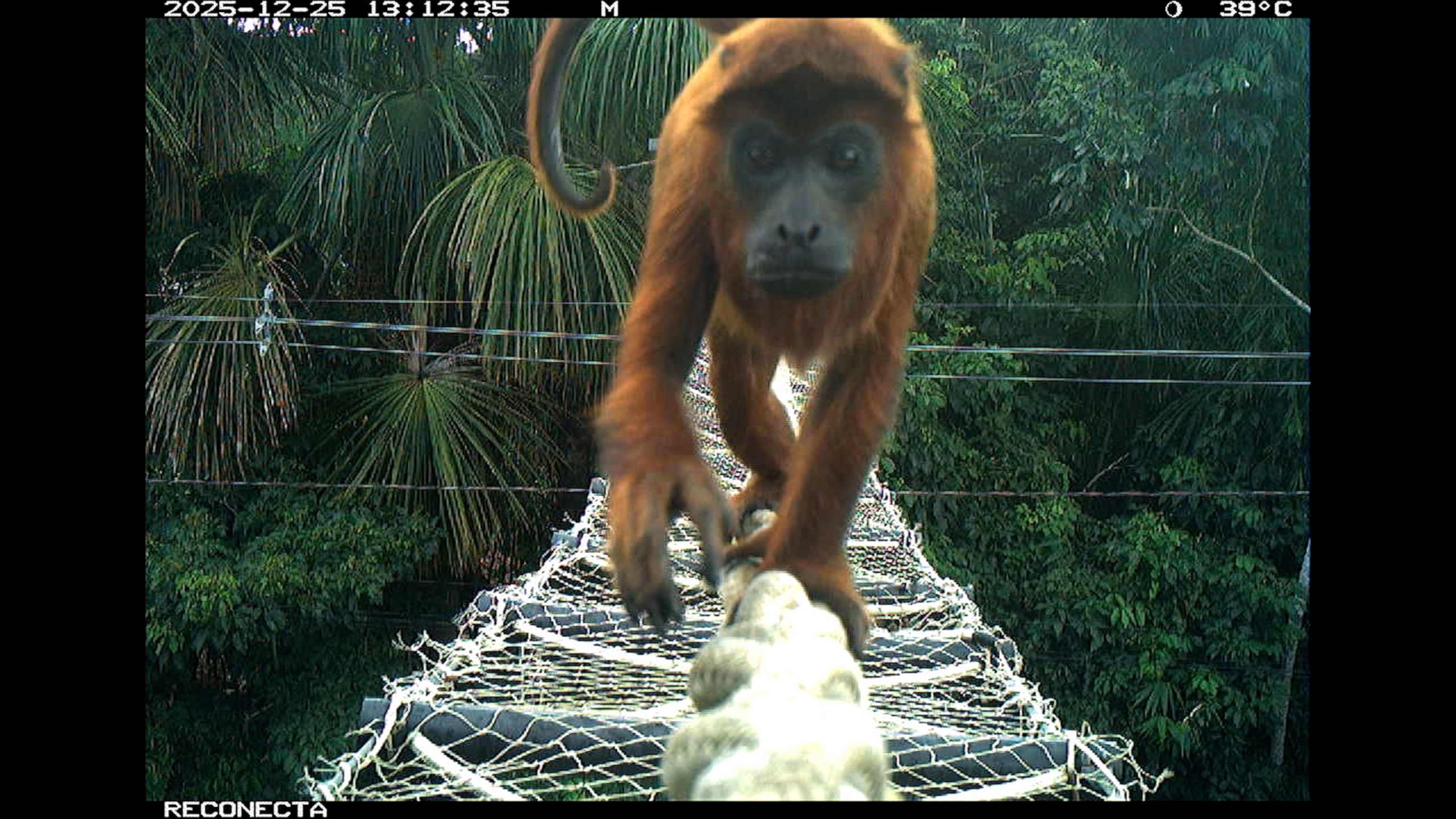
Howler monkeys from a newly described species, Alouatta matogrossensis, scamper across a canopy bridge in Alta Floresta, Mato Grosso, Brazil. The crossings, constructed by the non profit Reconecta Institute, have led to a dramatic decline in roadkill deaths.
RECONECTA INSTITUTE/SNZCBI
It’s a common storyline in conservation—a new species is discovered, and before there’s time to get out the Latin dictionary for naming, scientists realize the animals are already imperiled. Less common: To discover a new threatened species and find out it’s already being protected by an inspiring effort.
That’s what happened in the case of one of the world’s newest howler monkeys, Alouatta matogrossensis. Before an international team of scientists published their findings announcing the new South American species in Communications Biology in October, they reached out to Projeto Reconecta, an initiative that aims to construct numerous rope bridges to span Brazil’s roadways. These crossings act as safe passage for animals in the rainforest canopy, stitching together the tattered fabric of a once pristine ecosystem.
Among thousands of camera-trap photos from the bridges of wildlife using the crossings—including capuchins, marmosets, and titi monkeys—the researchers spotted the new matogrossensis. “We were all amazed that we were providing safe crossing opportunities for a new monkey species,” says Fernanda Abra, a road ecologist and National Geographic Explorer who leads Reconecta.
Those images were “super important,” says study co-author Romina Batista, an evolutionary biologist at the National Institute of Amazonian Research, “knowing that there was a project in that region helping these animals, keeping their gene flow across the fragmented areas. That has a huge impact on maintaining this brand-new species that we just described.”
Howlers are among the largest primates in the Western Hemisphere, found throughout Central and South America, and known for their extremely loud 100-plus decibel calls. Howlers announce themselves so loudly they can be heard miles away—but finding the new species still required painstaking work.
Matogrossensis are found in the Brazilian state Mato Grosso (hence the name), in the southern Amazon Rainforest. While they are a bit darker and redder than their closest relative, the Aloutta sara that lives across the border in Bolivia, an average person might have difficulty telling them apart. Their distinctiveness, instead, lies deeper. The new study compiles genetic evidence from decades of samples found across the Amazon, and reveals this population has likely been its own species for more than half a million years, isolated by rivers on one side, and the bordering Cerrado, a tropical savannah ecosystem, on the other.

Fernanda Abra, co-founder of Projeto Reconecta and a National Geographic Explorer, installs a camera trap on a canopy crossing in Alta Floresta. With...Read More ---Read More
Reconecta Institute/SNZCBI
Like other species in the region, they are likely in grave danger. “They're found in a place where the forest is at its worst shape in the whole of Brazil,” says study co-author Jean Boubli, a primatologist at the University of Salford in the UK and National Geographic Explorer. In Mato Grasso, expansion of the agricultural industry has historically led to some of the highest deforestation rates in all the Amazon. Over decades, natural habitat has been cleared for soybean crops and cattle pasture. Even roadways built through remote areas are enough to sever animals from one another. Abra says that the rope bridge that m atogrossensis was spotted on is in Alta Floresta, a small but growing urban center. “The cities are getting bigger,” Abra says of the municipalities in the region. “So there is more agriculture, agriculture fields, cars everywhere.” That also means more roadkill involving primates.
While scientists have yet to formally list the species with the International Union for Conservation of Nature, Boubli believes “it's either endangered or critically endangered,” based on the degraded state of the local environment.
Previously, scientists would have assumed the howler in Abra’s photo was part of a robust, common species known as the Purus red howler (Alouatta puruensis). Proving it’s a new species with a smaller distribution might unlock more resources and urgency to save it.
Boubli has been exploring the Amazon, collecting samples of primates for nearly 30 years, and still he’s surprised at the biodiversity he continues to find. Indeed, this new paper names not one, but two new species of howler, bringing the researchers’ total count of howler species to 16 so far. The second, now called Alouatta iroi, lives further north in the Amazon. Its name borrows a word for Howler monkey in a Yanomami indigenous language, and it appears to be around 700,000 years old, also cut off from a sister population by a river.
And so, the study reaffirms the power of dividing lines in the rainforest. Natural features like rivers can generate immense biodiversity over hundreds of thousands of years, just as artificial barriers like roadways can destroy it in a few generations.
"We really need to be careful here, because we can't just plow through areas without knowing what was there,” Boubli says. Meanwhile, Abra says her bridges now serve three recently discovered monkey species: the critically endangered Alta Floresta titi monkey, first described in 2019; the Schneider’s marmoset, discovered in 2021; and now the matogrossensis. So far, the spans seem effective at preventing roadkill deaths.
That scientists are still finding new species of big loud conspicuous monkeys makes Boubli wonder about all the untold, more clandestine critters—the beetles, the butterflies, and so on—that also are waiting to be discovered, if we can just keep their ecosystems intact.
Brian Resnick is a digital editorial manager at National Geographic.
Related Topics
You May Also Like
ANIMALS ## Meet the First New Cat Species Discovered in 100 Years

TRAVEL ## What it’s like to spend a night in a Costa Rican jungle

ANIMALS ## Can we save the hammerhead shark from extinction?
PHOTOGRAPHY ## A Century of Photographing Lions in National Geographic

ANIMALS ## Wasp named after Sir David Attenborough for his 100th birthday
The best of National Geographic delivered to your inbox
Email Address
Yes! I would like to receive top content, special offers, and other updates from National Geographic and The Walt Disney Family of Companies. By creating an account, you agree to our Terms of Use and acknowledge that you have read our Privacy Policy and US State Privacy Rights Notice.
Follow us National Geographic Instagram National Geographic Facebook National Geographic Twitter National Geographic Youtube National Geographic Linkedin National Geographic Tiktok National Geographic Reddit
United States (Change)

Notice of Right to Opt Out of Sale/Sharing
Some US states provide residents (or their authorized agents) with the right to opt out of “targeted advertising,” “selling,” or “sharing” of personal information, as defined by applicable laws. You can move the toggle to the left and click “Submit” to opt out of such activities occurring through this digital property. If you are logged in, we may be able to associate your choice with your account and apply it to data sharing occurring through this digital property (across your browsers and devices) as well as other digital properties of The Walt Disney Family of Companies. You can confirm the status of your choice or opt out or in by clicking “Do Not Sell or Share My Personal Information” or “Your Privacy Choices” on each property.
Manage Consent Preferences
Selling, Sharing, Targeted Advertising
[x] Selling, Sharing, Targeted Advertising
If you are not logged in, your opt-out will be specific to this property and device or browser. For our other digital properties, to opt out, select “Do Not Sell or Share My Personal Information” or “Your Privacy Choices” on each. If you clear your tracking history or use another browser or device, you’ll need to opt out again.
You can also submit this opt-out form, which may enable us to apply your opt-out more broadly, for example, to stop data sharing in connection with advertising intended to reach you on platforms not operated by Disney (e.g., social media platforms).
You may enable online, where available, a universal tool that automatically communicates your opt-out, such as Global Privacy Control (“GPC”), which we’ll process as if you had opted out through the toggle.
Even if you opt out, you may continue to see advertising, including ads that may be based on personal information processed before you opted out. Please visit Your US State Privacy Rights for more information about your rights and how to exercise them.
Cookie List
Clear
- [x] checkbox label label
Apply Cancel
Consent Leg.Interest
[x] checkbox label label
[x] checkbox label label
[x] checkbox label label
Submit
Enter your email to read this article
Plus, get unlimited access to free National Geographic content
Email Address
SUBMIT
Yes! I would like to receive top content, special offers, and other updates from National Geographic and The Walt Disney Family of Companies. By creating an account, you agree to our Terms of Use and acknowledge that you have read our Privacy Policy and US State Privacy Rights Notice.
Already have an account?