Microplastic Brazilian Pantanal Wildlife Anteaters Tapirs
Topics—
Latest—

Newly Discovered Monkey Pops Up in Camera Trap Footage

Rare Water Mouse Rediscovered After Almost 100 Years

Striking Photos Reveal the Legacy of Yellowstone’s Wolves

The Hidden Ways Wolves Keep an Ecosystem Healthy
Nat Geo Recommends—
Meet the First New Cat Species Discovered in 100 Years
Topics—
Latest—

Michelangelo and the Tomb that Tormented Him

premium
A Famous Portrait of Anne Boleyn Hides a Strange Secret

premium
Will the Bayeux Tapestry Finally Give Up Its Secrets?
How Sleuths Decoded the Secret Letters of Mary, Queen of Scots

How Sleuths Decoded the Secret Letters of Mary, Queen of Scots
Nat Geo Recommends—
Inside the New Expedition to Find Amelia Earhart's Plane
Topics—
Latest—

England’s Forgotten Castle Trail—And the Woman Behind It

15 Spectacular Journeys by Land, Sea and Sky
Inside the Exclusive-Access Boom in Luxury Travel, From Islands to Palaces

Inside the Exclusive-Access Boom in Luxury Travel, From Islands to Palaces
Musician Kate Nash on Her Irish Heritage and the Reality of Touring

Musician Kate Nash on Her Irish Heritage and the Reality of Touring
Nat Geo Recommends—
Where to Go for a Fall Leaf-Peeping Road Trip
Topics—
Latest—

premium
Rethinking How to Fight the World’s Deadliest Infection

premium
Could the Way You Chew Food Affect Your Dementia Risk?
Can a Controversial Diet Help Treat a Hidden Cause of Migraines?

premium
Can a Controversial Diet Help Treat a Hidden Cause of Migraines?

premium
The Case for Buying Kefir Over Yogurt
Nat Geo Recommends—
Your Neighborhood Could Influence Your Dementia Risk
Science & Nature—
Latest—

Paid Content
From Farm to Future

Life Inside a Sinking City
Scientists Discover a Neuron That May Play a Role in Schizophrenia

premium
Scientists Discover a Neuron That May Play a Role in Schizophrenia

Microplastics Detected in Brazil’s Most Remote Wildlife
Featured—
Watch Nat Geo on Disney+



Watch the Sharkfest collection on Disney+

National Geographic Society—
More—


Scientists Detect Microplastics in Animals From Brazil’s Most Pristine Wetland
Scientists sampled the blood of wild anteaters and tapirs in the Brazilian Pantanel—and made a few surprising finds about which animals were most at risk.
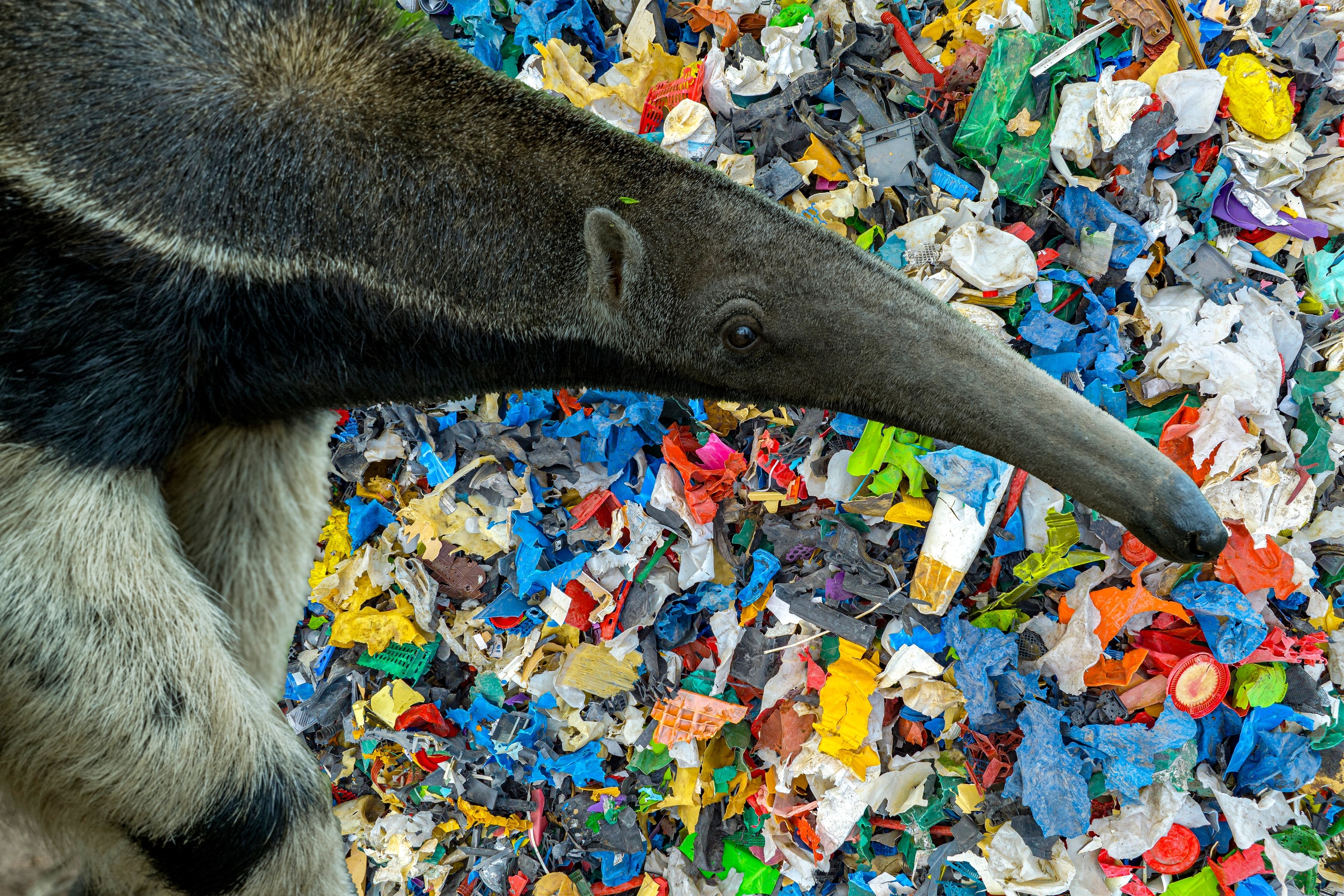
A new study documents microplastics in Brazilian wildlife living in remote regions.
Photo Illustration: NGM Staff; Source Photo for Illustration (Composite): Air Creative/Getty Images; Wolfgang Kaehler/Getty Images
Deep in Brazil’s Pantanal, the largest and most pristine wetland in the world, the iconic tapir roams, its short snout snuffling the dirt, feeding off the twigs and seeds embedded in the ecosystem’s fertile soil. For these pony-sized mammals it’s a remote paradise, miles from any kind of human development. But running through some of their veins is an all-too-familiar imprint of industry: microplastics.
New research recently published in the journal Nature tracked the movements of giant anteaters and tapirs and measured the amount of microplastics in their blood.
The research found, rather unsurprisingly, that proximity to people lead to a higher level of microplastics. But more striking is that 14 animals sampled in the remote Pantanal, more than 40 miles away from the nearest town or building, also had plastic in their blood, underscoring the staggering reach of these tiny particles, which can travel through air and water.
“I honestly wish we had found no microplastics in those animals,” says Marcia Ferraz, the paper’s lead author. “Brazil has some of the most unique wildlife in the world, and it is also a place where that wildlife faces serious pressure, so finding plastic inside these animals, even in the most preserved places, was hard to see.”
The paper adds to a growing body of researching documenting microplastics in some of the world’s most untouched places. A study published in October found them in the snowpack that blankets remote parts of the Sierra Nevada. Microplastics have been linked to health problems including heart disease and cognitive decline, making their ubiquity concerning and urgent to understand.
While studies have measured where microplastics are present and how they move through marine food webs, there’s relatively little research studying all the direct and indirect ways microplastics accumulate on land. “This project nicely goes beyond simple observation of plastics contamination to quantifying the plastics and assessing a spatial relationship with a human footprint,” says Matthew Campen, an expert on microplastics in the body at the University of New Mexico, who wasn’t involved with the paper.
“From the terrestrial side of things, I would say this is new,” adds Susanne Brander, who directs scientific advancement with The Pew Charitable Trusts' safer chemicals project and was also not involved with the new study.
Ferraz, who is a professor and veterinarian and works with local governments on wildlife conservation, decided in 2018 to launch this research with one of her co-authors Michael Noonan, an assistant professor at the University of British Columbia Okanagan who studies conservation, animal movement, and statistical modeling.
Brazil, where Ferraz is from, proved in many ways an ideal spot to study how tiny bits of plastic pollute wilderness. The country is rich in diverse biomes and has seen, over the past two decades, a remarkable increase in human development in these once-remote parts. From 2001 to 2020 the human footprint index increased 26 percent globally, but in Brazil it increased by 42 percent. There were also local organizations already tracking these animals, giving the study authors data to then examine how proximity to people affected their levels.
You May Also Like

MAGAZINE ## Helping an animal vital to Brazil’s rainforest survive
ANIMALS ## Making Way for the Giant Anteaters of Brazil
ENVIRONMENT ## Is cutting back on plastic really worth all the effort?
Some of the findings were unexpected. Ferraz notes that the amount of detectable plastic was relatively consistent across the species they observed despite their different sizes, shapes, and diets. “It means that plastics are everywhere,” she says. “It’s independent of your food chain.”
One of the youngest animals observed had the highest level of microplastics in their blood. Ferraz hypothesizes it could be because younger animals are more curious. “Maybe they’re getting closer to people,” she says.
These animals weren’t picked by accident; they are integral to the ecosystem and culture of Ferraz’s homeland. She remembers drawing giant ant eaters when she was a little girl in school. Tapirs, the largest mammal native to the country, however, has garnered a somewhat less esteemed reputation. To tell someone they’re being clueless or an airhead, a Brazilian might called them an anta, the Portuguese word for tapir. But these odd-looking creatures are crucial pollinators who digest and widely disperse seeds.
“They’re the gardeners of the forest,” says Ferraz. “Without them ecosystems could collapse.”
The giant anteater’s population, meanwhile, is in decline across much of the country. In the savannah of Brazil’s Cerrado, historically a stronghold for the species, development has accelerated, increasing concerns about the well-being of the population, says Noonan. As more roads are built through their habitats to sustain the country's rapid development, anteaters are more frequently being struck by vehicles. (Read more about the work to save Brazil’s anteaters from vehicle strikes.)
One gap in the research is that the scientists’ technology was unable to measure some of the smallest and most nefarious of plastic derivatives, nanoplastics. These more readily absorb into the bloodstream, says Campen. “I do not think this changes the conclusions from the study,” he adds. “In fact, I think it would only hammer home the point further if they had provided such data.”
The study also stopped short of investigating whether there were health impacts linked to the plastics in these animals’ blood. In controlled settings, Ferraz has found that microplastics have effects on fertility, but conducting those experiments in remote parts, at times only reachable by helicopter, proves a bigger challenge.
The findings also emphasize another broad challenge to microplastic research. In the quest to understand the effects of plastic pollution, it’s becoming harder to find control zones, or places untouched by it.
“Plastic production, chemical production, it's not something we can contain in urban areas or in factories,” says Brander. “These chemicals and particles are mobile. They move around in water, they move around in the atmosphere.”
Ruby Mellen is a freelance writer based in Washington, D.C. She reports on climate change, science, and international affairs.
Related Topics
You May Also Like

SCIENCE ## Alarming levels of microplastics found in human brains

ENVIRONMENT ## When ships are nearby, sperm whales change their calls
ENVIRONMENT ## Here's how plastics experts decorate for the holidays

ANIMALS ## These baby animals captured Joel Sartore's heart
ENVIRONMENT ## Why are Alaska’s rivers turning bright orange?
The best of National Geographic delivered to your inbox
Email Address
Yes! I would like to receive top content, special offers, and other updates from National Geographic and The Walt Disney Family of Companies. By creating an account, you agree to our Terms of Use and acknowledge that you have read our Privacy Policy and US State Privacy Rights Notice.
Follow us National Geographic Instagram National Geographic Facebook National Geographic Twitter National Geographic Youtube National Geographic Linkedin National Geographic Tiktok National Geographic Reddit
United States (Change)

Notice of Right to Opt Out of Sale/Sharing
Some US states provide residents (or their authorized agents) with the right to opt out of “targeted advertising,” “selling,” or “sharing” of personal information, as defined by applicable laws. You can move the toggle to the left and click “Submit” to opt out of such activities occurring through this digital property. If you are logged in, we may be able to associate your choice with your account and apply it to data sharing occurring through this digital property (across your browsers and devices) as well as other digital properties of The Walt Disney Family of Companies. You can confirm the status of your choice or opt out or in by clicking “Do Not Sell or Share My Personal Information” or “Your Privacy Choices” on each property.
Manage Consent Preferences
Selling, Sharing, Targeted Advertising
[x] Selling, Sharing, Targeted Advertising
If you are not logged in, your opt-out will be specific to this property and device or browser. For our other digital properties, to opt out, select “Do Not Sell or Share My Personal Information” or “Your Privacy Choices” on each. If you clear your tracking history or use another browser or device, you’ll need to opt out again.
You can also submit this opt-out form, which may enable us to apply your opt-out more broadly, for example, to stop data sharing in connection with advertising intended to reach you on platforms not operated by Disney (e.g., social media platforms).
You may enable online, where available, a universal tool that automatically communicates your opt-out, such as Global Privacy Control (“GPC”), which we’ll process as if you had opted out through the toggle.
Even if you opt out, you may continue to see advertising, including ads that may be based on personal information processed before you opted out. Please visit Your US State Privacy Rights for more information about your rights and how to exercise them.
Cookie List
Clear
- [x] checkbox label label
Apply Cancel
Consent Leg.Interest
[x] checkbox label label
[x] checkbox label label
[x] checkbox label label
Submit
Enter your email to read this article
Plus, get unlimited access to free National Geographic content
Email Address
SUBMIT
Yes! I would like to receive top content, special offers, and other updates from National Geographic and The Walt Disney Family of Companies. By creating an account, you agree to our Terms of Use and acknowledge that you have read our Privacy Policy and US State Privacy Rights Notice.
Already have an account?