China's Long-Term Auto Bet is Winning
Bloomberg the Company & Its Products The Company & its ProductsBloomberg Terminal Demo RequestBloomberg Anywhere Remote Login Bloomberg Anywhere LoginBloomberg Customer Support Customer Support
Bloomberg
Connecting decision makers to a dynamic network of information, people and ideas, Bloomberg quickly and accurately delivers business and financial information, news and insight around the world
For Customers
Support
Americas+1 212 318 2000
EMEA+44 20 7330 7500
Asia Pacific+65 6212 1000
Company
Communications
Follow
Products
Industry Products
Media
Media Services
Company
Communications
Follow
Products
Industry Products
Media
Media Services
Bloomberg
Connecting decision makers to a dynamic network of information, people and ideas, Bloomberg quickly and accurately delivers business and financial information, news and insight around the world
For Customers
Support
Americas+1 212 318 2000
EMEA+44 20 7330 7500
Asia Pacific+65 6212 1000
More
US Edition
Video 2
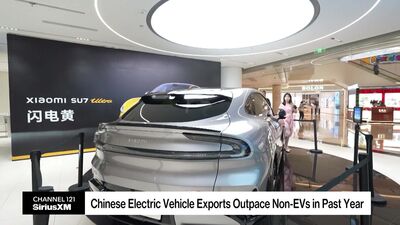
China's Long-Term Auto Bet is Winning
Video Player is loading.
Mute
Current Time 0:08
Loaded: 7.67%
0:08
1x
Playback Rate
2x
1.75x
1.5x
1.25x
1x, selected
0.75x
0.5x
0.25x
captions off, selected
English
This is a modal window.
Ad 0:01
China's Long-Term Auto Bet is Winning
China has emerged as the global leader in electric vehicles, combining advanced technology, highly automated factories and a dense battery supply chain to produce increasingly sophisticated cars at competitive prices. Bloomberg Businessweek Editor Brad Stone says Chinese automakers have benefited from years of government support and long-term industrial planning, while shifting US policies have made it harder for American companies to make similar investments.
Playlist
2. ### Stocks Fall Ahead of Nvidia, Trump-Xi-Putin Summit; Huang’s Potential Return to Nvidia Duration:42:27
3. ### Nvidia’s CEO Search Draws Fire With Bessent’s ‘Shakeup’ Call Duration:1:28
4. ### Trump Says Jensen Huang Did Not Put National Security at Risk Duration:3:47
5. ### Putin-Xi Meeting Unlikely to Bring Substantive Results for Trump, Says Jane Harman Duration:8:26
6. ### US Moves to Curb China’s Chip Access Duration:52:26
7. ### 'Essential' That US Upholds Export Controls on Chips, Says Ben Buchanan Duration:7:42
10. ### Stifel CEO on Anthropic, Integrating AI and Fed Policy Duration:7:37
11. ### Nvidia, Anthropic Put the AI Trade On Trial Duration:87:17
12. ### Nvidia’s CEO Search Draws Fire With Bessent’s Shakeup Call Duration:6:00
13. ### Fed's Warsh Says Staff Are Sketching Out AI Contingencies Duration:2:42
14. ### McKinsey’s Sternfels on Corporate Crisis Management, AI Impact Duration:10:09
15. ### Hadrian Targets Critical Bottleneck in US Shipbuilding Duration:5:12
16. ### Nvidia Earnings to Test AI Boom as Hike Looms Duration:3:54
0:00
Brad, you've already spent some time talking to us about your recent trip to
0:04
China. Um, what we didn't touch on was these
0:06
so-called smart phones on wheels that we've been hearing about for a couple of
0:09
years. And in fact, you even had Ford CEO a
0:12
couple of years ago, not wanting to give up his Chinese EV that he was able to
0:17
drive around for for a few months. What did you see on the roads there that
0:21
blew you away? A lot of innovation, Tim.
0:25
A lot of choice. Um, Chinese automakers are trying a lot
0:29
of different things. Some of it's visible on the outside
0:33
light are in. And, you know, your your standard EV,
0:37
um, sensors where you can open the door without a key, you know, inside the car,
0:42
massage chairs, uh, in the, in the back seats, um, weird sort of robotic, uh,
0:48
displays where the eyes follow you if you're talking to the car.
0:52
Um, but also, you know, things that you can't see, mileage, you know, EVs that
0:58
extend 400, 500 miles and then price. I mean, this is the strength of the
1:03
Chinese auto industry right now. We're basically 60% of all cars are EVs.
1:09
Is their expertise in manufacturing and robotics and the density of the supply
1:13
chain, uh, batteries make up about half the cost of an EV.
1:16
And you've got BYD and Catl, the two biggest manufacturers of batteries, uh,
1:22
for cars in the world that are there. And so China has a lot of advantages
1:26
because they have cultivated this expertise.
1:29
It started with a long term plan from the government and private industry has
1:33
followed suit. Right.
1:34
And you can also get I love is a BYD that's got, uh, a car that's got a roof
1:38
mounted, um, drone on it so you can get just about everything.
1:41
You need a drone, talk about options, talk about options.
1:44
But what's interesting is the Chinese model, right?
1:46
They love the government, loves companies to be competitive.
1:50
They encourage it. And as a result, you get a lot of
1:53
companies doing some pretty cool stuff, right?
1:57
Yeah, exactly. Um, I think it was 2015 where China
2:02
introduced its first long range ten year plan, where they talked about dominance
2:06
in the EV market. And you know, these things, it's you can
2:10
argue about how much coordinated action there is.
2:12
But the way I describe it in the piece is a kind of a bat signal to not only
2:17
venture capitalists and automakers, but also local governments and start
2:21
provisioning land for factories and competing to bring companies like Geely
2:26
Automotive that I wrote about in the piece, uh, you know, to their province,
2:30
set up state of the art factories. I visited one, a Geely factory where
2:35
there's a big sign, uh, in Mandarin, calling it a dark factory so it can
2:40
operate with the lights off. It is the symphony of automation and
2:44
robotic arms, kind of bringing all the advantages of the Chinese supply system
2:48
to bear. It's also that's one factory, but it's
2:51
surrounded by all of their suppliers. So there's just total density in the
2:56
supply chain, which is why I like Jim Farley, when he went in and took his,
3:00
uh, his, uh, his, uh, Shelby ev, he said touring, uh, a Chinese automobile
3:07
factory was the most humbling thing he's ever seen.
3:10
Uh, because they are kind of far ahead on in innovation, automation and
3:14
electric vehicle technology. So do well, let's let's separate Europe
3:18
and the United States into two distinct, uh, geographies, which they are, but
3:23
also they have different rules about these cars being imported into them.
3:29
Do just BMW does, VW does, Ford does.
3:35
Do they, do they stand a chance competing with these companies?
3:38
I mean, I think I think what we're going to see is so let's go back 25 years.
3:42
And that's the framing, as you guys know, of the of the issue.
3:45
When China joined the World Trade Organization, you know, there was panic
3:49
inside China about what, uh, globalization would do to the Chinese
3:53
auto industry. And they were talking about raising
3:55
tariffs 50% to protect the state owned automakers, and eventually, as a
4:01
condition of joining the WTO, they had to start at 25% and gradually bring it
4:05
way down. And what the Chinese automakers were
4:08
doing and then increasingly did is create joint ventures.
4:13
And I mean, I remember the old Chinese taxi cab was called the Volkswagen
4:17
Santana because these were and it was a horrible looking car.
4:20
But these were joint ventures. And the Chinese automakers learned late
4:24
June of Show Me. The reason that he started an EV
4:27
industry is he met Elon Musk in Silicon Valley.
4:30
He bought his own Tesla, and he he really admired it.
4:33
So I think the script has to be flipped. And I think the Western automakers have
4:37
right now are somewhat protected, particularly in the US, from Chinese
4:41
competition, because we cannot buy these these state of the art Chinese
4:45
automobiles in the United States. I think they've got to start taking that
4:49
Chinese mentality and learning. And so these are joint ventures,
4:53
factories in different parts of the world where they can co-produce and
4:57
start to, you know, learn and nurture the same kind of ecosystem in the West
5:00
start to, you know, learn and nurture the same kind of ecosystem in the West
5:01
that exists in China. And that is going to take many, many
5:04
years. And frankly, we haven't really even
5:06
gotten started. You know, it's interesting at a time
5:08
when we talked so much about Nvidia over the past week, and we know Jensen Huang,
5:12
the former CEO, you know, thought was very much in favor of sharing Chinese
5:18
sophisticated or U.S. Nvidia sophisticated chips with China.
5:22
Like you do wonder Brad, you know, is it time for the American auto industry to
5:26
kind of see what the Chinese technology does, introduce it into the United
5:31
States, and, you know, let the the best winner win, you know, make it a
5:37
contender. It's incredibly sensitive, right,
5:40
because you're talking about American jobs and factories and tradition and
5:45
pride. Um, you know, we have enormous pride in
5:47
our automobile factory. It's not just in the state of Michigan,
5:50
but but really around the country. And there's an argument that is made by
5:54
the by the unions, by the automobile companies, that China competes unfairly.
5:59
And that's a debate to have. But, you know, to a certain extent that
6:02
there's there are subsidies. And these factories that I visited, they
6:05
come in with a lot of local and state support.
6:08
And so, you know, there are arguments that it's unfair competition, but you
6:12
can't really complain, uh, when the rules of the game are what they are.
6:17
And so I think you, I think the West, in countries like the U.S.
6:21
have to do it in a way that, you know, is politically feasible and so protects
6:25
local jobs, protects the companies that America is proud of, but gradually opens
6:31
up to this larger world. And, you know, I think one of the things
6:34
obviously, the Trump administration has done is discourage the development of
6:37
EVs. We're at 7.4% of new car sold being
6:41
electric vehicles and plug ins. And that's just not the future.
6:44
The future is obviously long term not going to be combustible engines but
6:49
electric. And so I think, you know, the first
6:51
thing you have to do is start opening your eyes to the way the, uh, the
6:55
automobile industry is evolving. Yeah, I do wonder there's an auto
6:58
industry consultant that, uh, he's and also author of an upcoming book, Car
7:02
Wars, that you include in your, your, uh, story.
7:05
And, and he says, I can't find a country outside the US where I don't see Chinese
7:09
cars. And you do wonder, um, what happens if
7:13
we are the only market that doesn't embrace these cars?
7:16
Yeah. So.
7:17
So, Brad. Oh.
7:17
Go ahead. No, I was just going to say, I mean,
7:20
they're it's not just a business question.
7:22
It's a political question. Yeah.
7:24
Because yeah, there are countries and states in the US where, where, uh,
7:29
those, those voting interests are very powerful.
7:32
Totally. So it's not just industrial policy.
7:35
What I want to dive into a little bit is, is what, in your view, after after
7:39
the time in the reporting that you spent doing this, what what led the Chinese
7:43
companies to essentially leapfrog legacy automakers so quickly and in such a
7:48
short period time? I know you talked about the supply chain
7:50
and the control of the battery technology, but but is there something
7:54
more there? And is there something more when it
7:57
comes to a lack of labor unions? Is it something when it comes to, um,
8:01
the idea of, of work and the way that work fits into somebody's life there
8:05
differently than it does here in the United States?
8:08
Like, what are what are global companies and, uh, competing with when they
8:12
compete against Chinese automobiles? I think the most important thing is the
8:16
long term signaling from the central government that this is that this is the
8:22
best a long term bet, a ten year plan, uh, and the direction that they want to
8:27
bring the auto industry. And so in 2015, as I mentioned, uh, the
8:31
Chinese government identify the dangerous dependency, uh, on foreign
8:36
oil, on fossil fuels. And, and they said, you know, that it
8:40
was leading to pollution in the cities and congestion, uh, but also the
8:45
potential for, you know, military conflict, uh, for inflation and
8:49
political unrest. And so they said the future is electric.
8:52
And so when you have a stake in the ground like that, companies and
8:57
investors and workers, they can move in lockstep with a certain amount of
9:00
security. So I think, Tim, all the things you
9:02
mentioned are factors. But, you know, it's it's we don't have
9:06
to argue about political systems here. But, you know, having every four years
9:11
in America, different policy about EVs has been confounding for companies and
9:16
for the stewards of capital. So is it fair to say that the U.S.
9:19
with rare earths is taking a page out of China's book and what the Trump
9:23
administration is doing? Yeah, and and it's hard because the
9:26
write that that's one piece of the supply chain, uh, in, in, in batteries
9:32
and electric vehicles. And that's going to be incredibly hard
9:35
to duplicate, uh, in the U.S., if not impossible.
9:38
But, you know, there are other places in the world now, like countries where
9:41
where we could start to duplicate that. Um, and again, it's it's probably, uh,
9:45
creating joint ventures with companies like cattle and BYD, uh, and starting to
9:50
learn, you know, learn as much as we can and duplicate it.
Top Video

Duration:3:31 ### Anthropic IPO Is Delaying Some Deals, Moynihan Says
Duration:2:39 ### What to Watch for in Nvidia Earnings
Duration:8:21 ### Nouriel Roubini Sees Nvidia Crisis as a ‘Boon’ for US AI
Duration:1:49 ### US Airlines Race to Recover From Shutdown
Duration:10:18 ### Anthropic IPO Is Creating Luxury Home Buyers, Says Realtor Serhant #### Balance of Power
Duration:2:09 ### Fed's Hammack Prefers Moving Rates in Smaller Increments
Duration:14:26 ### Maryland Governor Moore on Midterms, FAA and AI Oversight
Duration:1:22 ### Robert Pattinson Is New James Bond in Amazon’s Reboot
Duration:5:16 ### How Private Equity Is Reshaping the Pentagon
Duration:3:06 ### JPMorgan’s Michele: ‘Looks a Bit Silly’ Fed Missed October Hike
Duration:11:10 ### Why GTA 6 Took 13 Years and $1 Billion to Make #### Weekly Docs
Available on:
Listen on Apple TVListen on RokuListen on Samsung TVListen on Fire TVListen on Android TVListen on Rakuten TVListen on Haystack News
Watch BTV in your area:
We've updated our terms
By accepting, you agree to our updated Terms of Service, including the arbitration provision and class action waiver. You understand that we process your information as described in the Privacy Policy, which may include sharing information about your use of Bloomberg.com with third parties. Accepting does not affect your right to opt-out at any time via the Do Not Sell or Share My Personal Information link in the website footer.
Accept